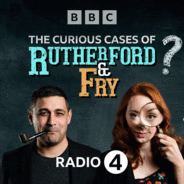
Can chemistry help us bake the perfect cake? Listener Helena McGinty aged 69 from Malaga in Spain asks, "'I have always used my mother's sponge cake recipe. But is there a noticeable difference in the outcome if you vary some of the ingredients, or the method?"In this episode Hannah and Adam go head to head in a competition to create the perfect cake using the power of science. They are aided by materials scientist Mark Miodownik, from University College London, with tips on how to combine the ideal ingredients and trusted techniques to construct a structurally sound sponge.Jay Rayner, food critic and presenter of Radio 4's The Kitchen Cabinet, is on hand to judge the results. But who will emerge victorious in this messy baking battle?Presenters: Hannah Fry, Adam Rutherford
Producer: Michelle Martin.
- im Online-Player
- im phonostar-Player
-
Was ist das?
Radio hören mit phonostar
 Um Radio anzuhören, stehen dir bei phonostar zwei Möglichkeiten zur Verfügung: Entweder hörst du mit dem Online-Player direkt in deinem Browser, oder du nutzt den phonostar-Player. Der phonostar-Player ist eine kostenlose Software für PC und Mac, mit der du Radio unabhängig von deinem Browser finden, hören und sogar aufnehmen kannst.
›››› phonostar-Player gratis herunterladen
X
Um Radio anzuhören, stehen dir bei phonostar zwei Möglichkeiten zur Verfügung: Entweder hörst du mit dem Online-Player direkt in deinem Browser, oder du nutzt den phonostar-Player. Der phonostar-Player ist eine kostenlose Software für PC und Mac, mit der du Radio unabhängig von deinem Browser finden, hören und sogar aufnehmen kannst.
›››› phonostar-Player gratis herunterladen
X