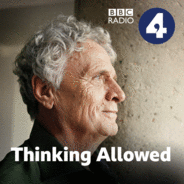
Will power and prosperity shift to the frozen North? A new book predicts that Iceland, Greenland, Denmark, Sweden, Finland, and Russia will be the beneficiaries of a new world order. By 2050, four megatrends - climate change, rising population, globalisation and resource depletion - will lead to the rise of 'The New North', as migration, energy bonanzas and international trade turn the world upside down. The geographer, Professor Laurence Smith, tells Laurie Taylor why these projections amount to more than planetary palm reading. Also, does the morality of the 19th century Temperance movement influence modern day attitudes to drinking? The law lecturer, Henry Yeomans, argues that prohibitionism - contrary to popular belief - lives on in 'binge drinking' Britain.
Producer: Jayne Egerton.
- im Online-Player
- im phonostar-Player
-
Was ist das?
Radio hören mit phonostar
 Um Radio anzuhören, stehen dir bei phonostar zwei Möglichkeiten zur Verfügung: Entweder hörst du mit dem Online-Player direkt in deinem Browser, oder du nutzt den phonostar-Player. Der phonostar-Player ist eine kostenlose Software für PC und Mac, mit der du Radio unabhängig von deinem Browser finden, hören und sogar aufnehmen kannst.
›››› phonostar-Player gratis herunterladen
X
Um Radio anzuhören, stehen dir bei phonostar zwei Möglichkeiten zur Verfügung: Entweder hörst du mit dem Online-Player direkt in deinem Browser, oder du nutzt den phonostar-Player. Der phonostar-Player ist eine kostenlose Software für PC und Mac, mit der du Radio unabhängig von deinem Browser finden, hören und sogar aufnehmen kannst.
›››› phonostar-Player gratis herunterladen
X